
10 Surprising Facts About Octopuses
Octopuses are among the most fascinating animals on Earth. They seem both familiar and completely alien at the same time: intelligent, curious, and adaptable — yet biologically so unusual that some scientists describe them as “alien-like.”
Here are ten scientifically documented facts that show why octopuses continue to surprise even researchers.
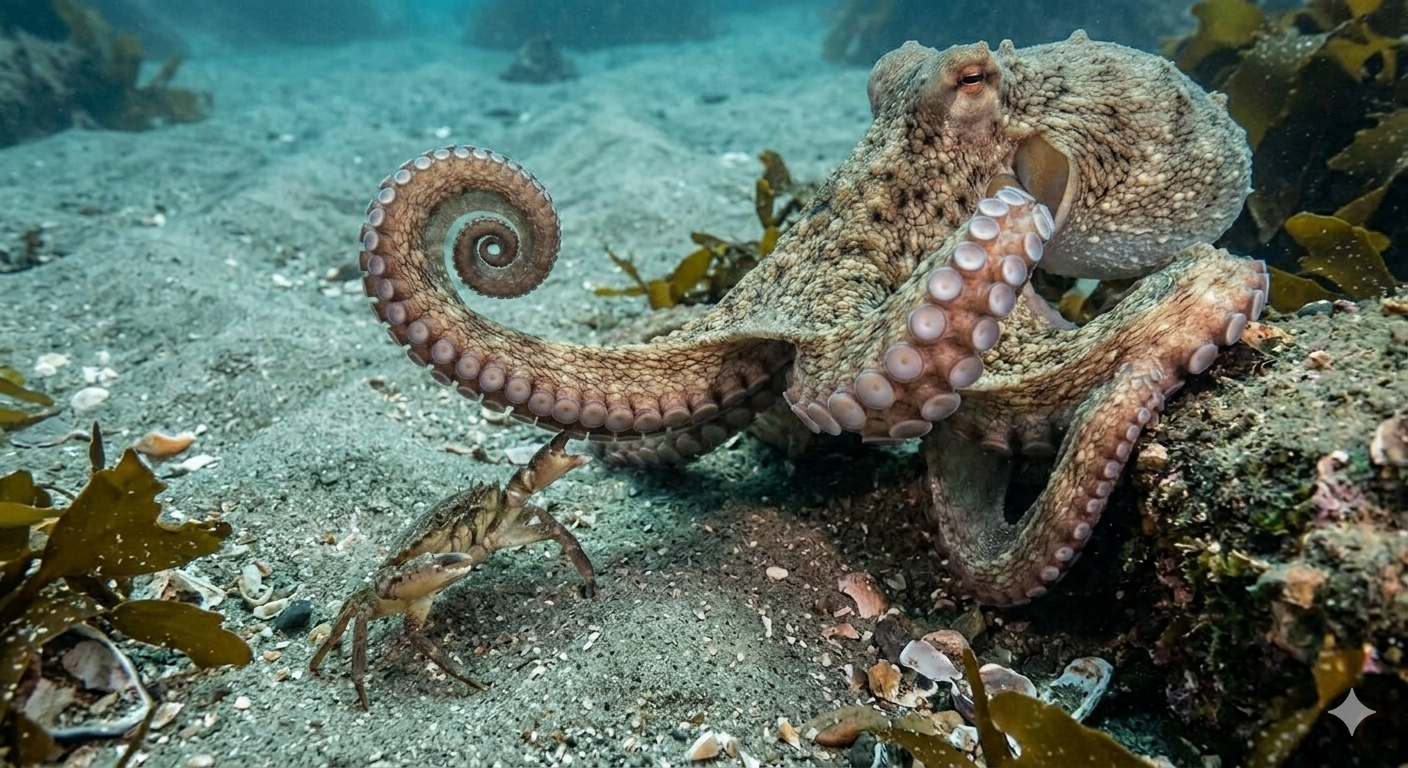
Crab and Octopus
1. Octopuses Have Three Hearts
Yes, really.
Two hearts pump blood through the gills
A third supplies the rest of the body with oxygen
Even more astonishing: When an octopus swims, its central heart temporarily stops beating. This is why many octopuses prefer crawling along the seafloor rather than swimming continuously. (Smithsonian Magazine)
2. Their Blood Is Blue
Humans transport oxygen using iron-containing hemoglobin. Octopuses, on the other hand, use hemocyanin, a copper-containing protein.
This makes their blood appear blue.
There is an advantage to this: Hemocyanin works particularly well in cold, oxygen-poor water — ideal for life in the deep sea. (Smithsonian Magazine)
3. Two-Thirds of Their Neurons Are Located in Their Arms
An octopus’s nervous system works very differently from ours.
Around two-thirds of its neurons are located not in the brain, but in the arms. This allows the arms to:
respond independently
investigate objects
coordinate movements
Researchers therefore sometimes refer to this as a form of “decentralized intelligence.” (Smithsonian Magazine)
4. They Can Taste With Their Arms
An octopus’s suckers are not only used for gripping.
They contain chemical receptors that allow the animals to “taste” their surroundings. An octopus can therefore simultaneously
feel
grip
and taste
… with the same arm. (Ocean Action Hub)
5. They Can Squeeze Through Tiny Openings
Octopuses have no bones. The only hard part of their body is their beak.
This means that if the beak can fit through an opening, the rest of the body can usually fit through as well.
This allows octopuses to:
escape from aquariums
squeeze through extremely narrow gaps
move in an almost “liquid” way
This ability has made them famous escape artists. (Ocean Action Hub)
6. Octopuses Use Tools
For a long time, tool use was considered something primarily associated with primates or birds.
But octopuses have been observed:
carrying coconut shells
later using them as shelter
deliberately manipulating objects
This is considered evidence of complex problem-solving behavior. (Smithsonian Magazine)
7. They Don’t Just Change Color - They Also Change Their Skin Texture
Octopus camouflage goes far beyond color.
They can:
change their patterns
alter the texture of their skin
and imitate rocks, coral, or sand with remarkable precision
This is made possible by specialized skin cells called chromatophores. Some species can change their appearance within fractions of a second. (BBC Earth)
8. Octopuses May Sleep in a Way Similar to Dreaming
In 2023, researchers published evidence in Nature of REM-like sleep phases in octopuses.
During these phases:
the animals rapidly change their skin patterns
move their eyes and arms
show increased neural activity
This does not automatically mean that octopuses “dream” in the same way humans do. But their sleep phases are clearly more complex than previously assumed. (Nature)
9. Octopuses Are Remarkably Intelligent
In experiments, octopuses have been able to:
open screw-top jars
solve mazes
remember solutions
distinguish between individual humans
They also show curiosity and individual behavioral differences.
For invertebrates, this is remarkable — and one of the reasons scientists are closely studying their capacity for sentience. (Smithsonian Magazine)
10. Octopus Mothers Sacrifice Themselves for Their Offspring
After laying their eggs, many females guard them for weeks or months.
They:
constantly clean the eggs
supply them with oxygen
defend them against threats
During this time, many females stop eating entirely and die shortly after the young hatch. (PBS)
Conclusion
Octopuses are not “simple sea creatures.”
They possess:
complex nervous systems
remarkable problem-solving abilities
extraordinary adaptations
and behaviors that continue to surprise even experienced scientists
Perhaps that is why they fascinate us so much: They show that intelligence and complex behavior can emerge in ways that are completely different from those found in humans.
And that is precisely what makes the question of how we treat these animals so relevant.