
An octopus can, within just a few seconds:
change its color
generate patterns
alter the texture of its skin
and become almost “invisible”
What looks like digital special effects is, in fact, pure biology.
The camouflage abilities of octopuses rank among the most complex adaptive feats in the entire animal kingdom — and they captivate not only biologists, but increasingly also materials scientists, robotics engineers, and AI researchers. (National Geographic)
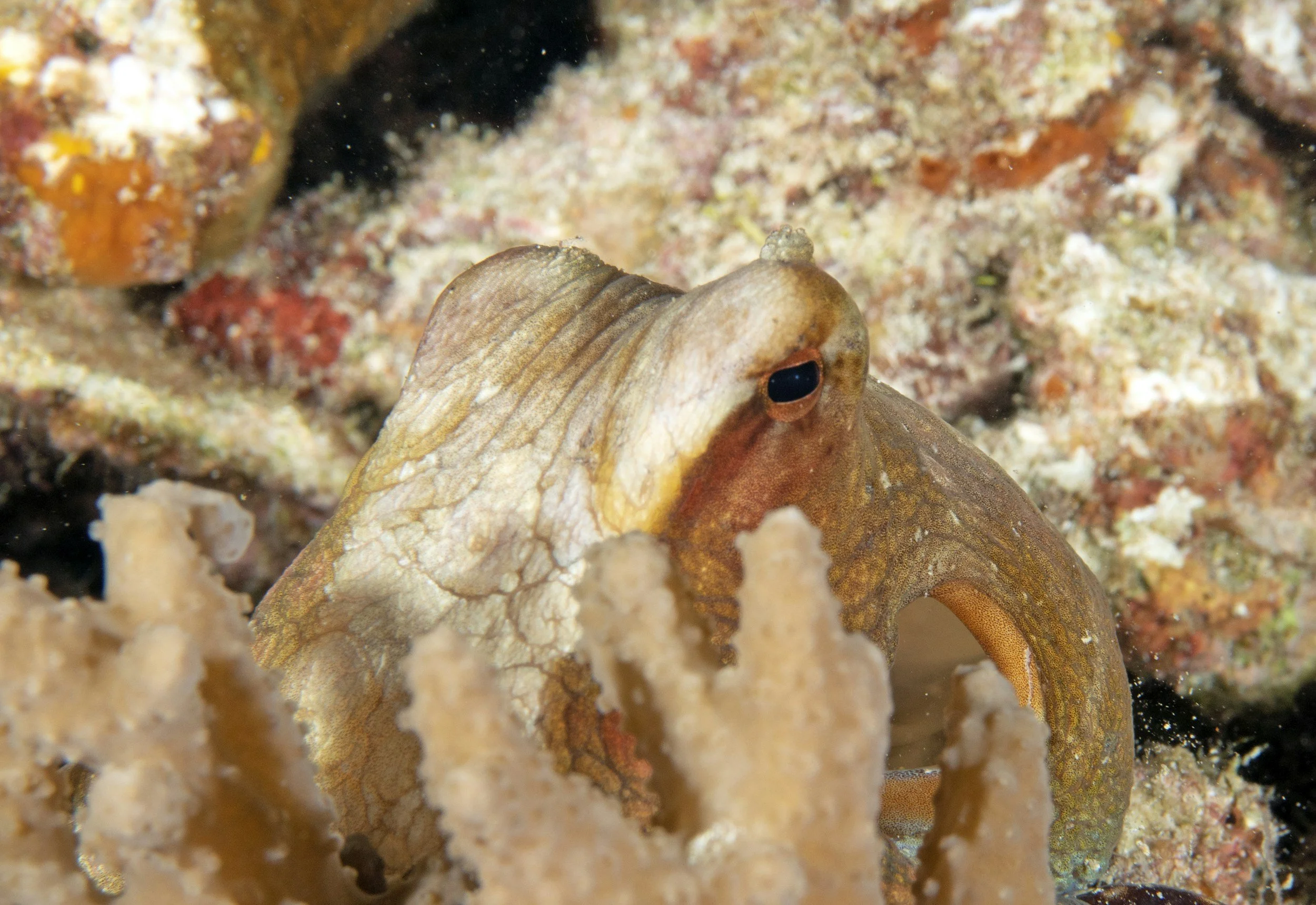
1. Camouflage in Real Time
Most animals are stuck with a fixed coloration. Octopuses, however, can continuously reinvent their appearance — depending on:
their surroundings
the light
danger
hunting conditions
mood or stress
The astonishing part: These transformations often occur in mere fractions of a second.
The video shows close-up footage of an octopus’s skin as it changes color.
4. Camouflage Depends on the Situation
Octopuses don’t always camouflage themselves in the same way. They adjust their strategy depending on what’s going on — deciding whether they should:
hide
warn
deceive
or prepare to hunt
Some species use camouflage defensively: 👉 “Please don’t look at me.”
Others use it offensively: 👉 “Come a little closer.”
This shows that camouflage isn’t just a reflex — it’s part of a complex behavioral repertoire.
5. The Mimic Octopus: Perhaps the Craziest Camouflage Artist in the Sea
One of the most famous masters of disguise is the Mimic Octopus (Thaumoctopus mimicus). It doesn’t just blend into its surroundings — it imitates other animals, including:
sea snakes
lionfish
flatfish
jellyfish
And it does so with remarkable accuracy, copying:
body posture
movement patterns
behavior
Researchers suspect that the octopus chooses whichever “role” is most useful depending on the threat. (The Times of India)
6. The Wildest Part: Octopuses Are Probably Color-Blind
Here’s where things get truly strange.
Even though octopuses can match colors with astonishing precision, many scientists believe they can only see colors in a very limited way.
👉 Their eyes likely contain just one type of photoreceptor.
Yet they still adjust their camouflage with uncanny accuracy.
How they manage this is still being investigated. Scientists suspect mechanisms such as:
brightness perception
light polarization
skin-based sensory feedback
or other processes not yet fully understood. (PubMed)
2. Chromatophores: The Color Cells of Octopuses
The foundation of octopus camouflage lies in structures called chromatophores.
These are tiny pigment-filled cells in the skin, containing shades of:
yellow
red
brown
black
Muscle fibers pull these pigment sacs open or closed, making the colors appear:
brighter
darker
larger
smaller
👉 Thousands of chromatophores work together simultaneously, producing remarkably complex patterns.
In addition, many octopus species possess:
Iridophores → reflective cells that create shimmering, iridescent colors
Leucophores → cells that help match the brightness of the surrounding environment
📚 Scientific background: IFLScience
3. Octopuses Can Even Change Their Skin Texture
Camouflage doesn’t stop at color.
Octopuses can actively modify the texture of their skin. They can:
smooth it
roughen it
form bumps
or mimic the appearance of algae and coral
Specialized muscle structures in the skin make this possible.
👉 This allows an octopus to look, within seconds, like:
a smooth stone
rough coral rock
or a tuft of algae
The video shows a mimic octopus imitating a striped fish.
7. Camouflage as Inspiration for Technology
The abilities of octopuses now inspire innovations in:
camouflage materials
soft robotics
adaptive surfaces
military research
AI‑assisted imaging systems
Researchers are trying to understand how octopuses:
process information
generate textures
and adapt themselves with such extraordinary flexibility. (National Geographic)
Why Humans React So Strongly to It
When people witness octopus camouflage, the same sequence tends to unfold: first confusion — then amazement.
Because suddenly, the animal appears:
fluid
malleable
almost unreal
And that’s exactly why videos of octopuses so often go viral.
They remind us just how alien — and how astonishingly complex — life on Earth can be.
Conclusion
Octopuses can:
change colors
generate patterns
alter their skin texture
imitate other animals
and become nearly invisible
All of this is made possible by:
chromatophores
reflective skin cells
flexible musculature
and an extraordinarily complex nervous system
The more we learn about them, the clearer it becomes: Octopus camouflage isn’t just a “trick.”
It is one of the most impressive biological abilities in the entire animal kingdom.