
Understanding Octopuses: Context, Terminology, and Common Misconceptions
Octopuses fascinate many people — yet there is often confusion about what exactly they are.
Are they “fish”?
What is the difference between an octopus and a “Krake”?
And what do terms like octopus, squid, or cuttlefish actually mean?
This article brings clarity.
1. Octopuses Are Mollusks — But Highly Complex Ones
Octopuses belong to the phylum Mollusca (mollusks).
That may come as a surprise, because this group also includes:
snails
clams and other bivalves
And yet, biologically, they are all part of the same phylum.
👉 Within the mollusks, octopuses belong to the class Cephalopoda — a highly developed group characterized by:
complex nervous systems
highly developed sensory organs
an active predatory lifestyle
Their scientific classification:
Phylum: Mollusca (mollusks)
Class: Cephalopoda (cephalopods)
Order: Octopoda
👉 “Octopoda” literally means “eight-footed.” This order includes all animals commonly known as octopuses.
2. Octopus vs. “Krake” — Is There a Difference?
In short: No — they refer to the same animal.
“Octopus” is the more scientific and internationally used term, derived from the Greek word “októpus”
“Krake” is the common German term
👉 Both terms refer to animals belonging to the order Octopoda.
Why are there two terms?
In German, “Krake” is sometimes used somewhat loosely — occasionally even for other cephalopods.
“Oktopus” is more precise and is therefore used more frequently in scientific contexts.
3. Their Relatives: What Else Belongs to the Cephalopods?
The class Cephalopoda includes several groups that are often confused in everyday language.
Here are the most important ones:
🐙 Octopus (Oktopus / Krake)
8 arms
no internal shell
usually solitary
highly flexible and intelligent

👉 Example: the common octopus (Octopus vulgaris), as shown in the image on the right:
By Diego Delso, CC BY-SA 4.0, https://commons.wikimedia.org/w/index.php?curid=118447006
🦑 Squid (squid in the narrower sense / calamari)
10 appendages (8 arms + 2 longer tentacles)
elongated body
often fast swimmers
frequently live in groups
They are often confused with octopuses, but their body structure is distinctly different.
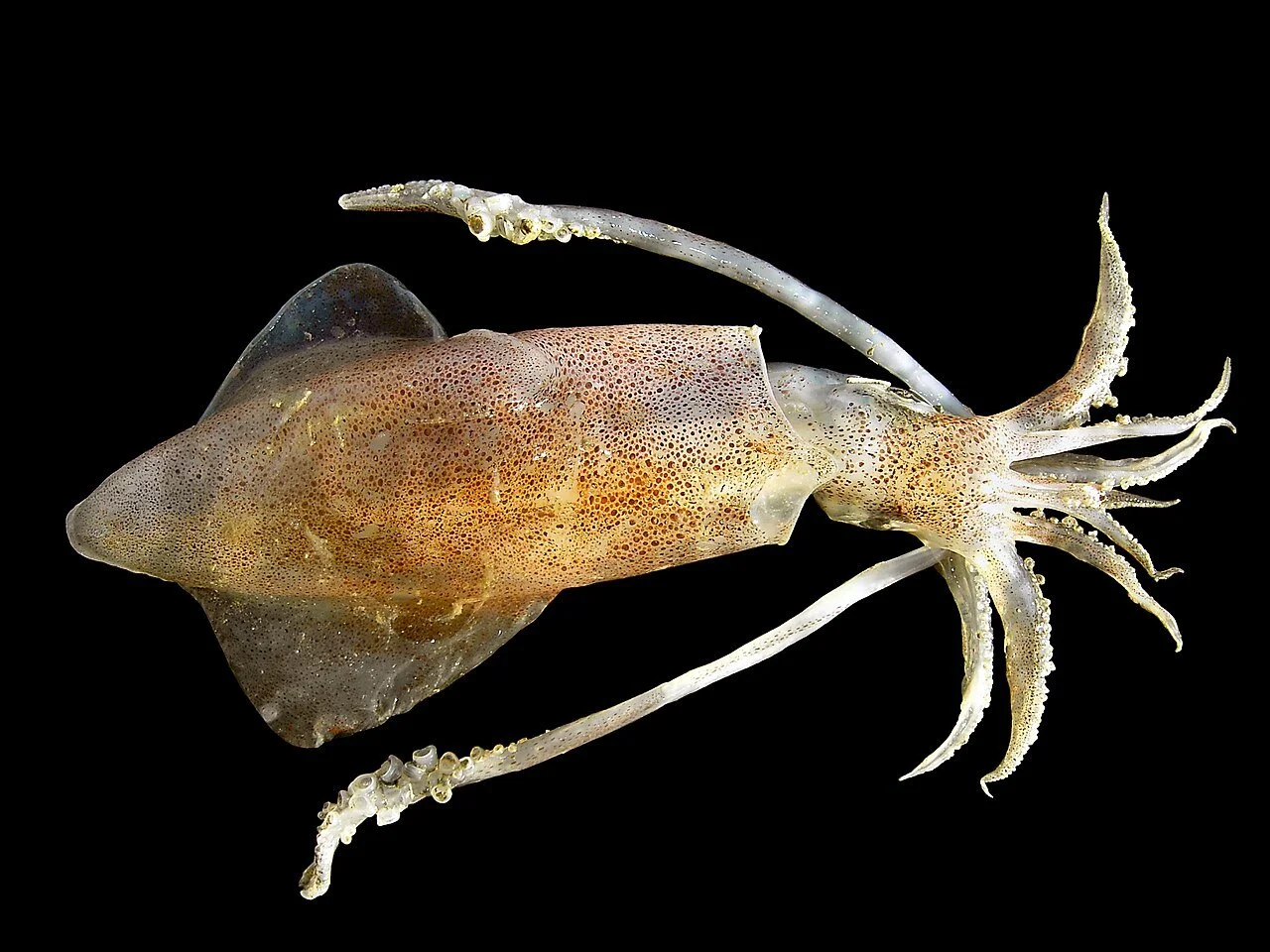
👉 Example: the European squid (Loligo vulgaris), as shown in the image on the left.
© Hans Hillewaert
Common squid from the Belgian continental shelf. Picture taken in the lab on board of the RV Belgica, of a live specimen to preserve colour and structure of chromophores. Mantle: length= 138 mm, width= 39 mm.
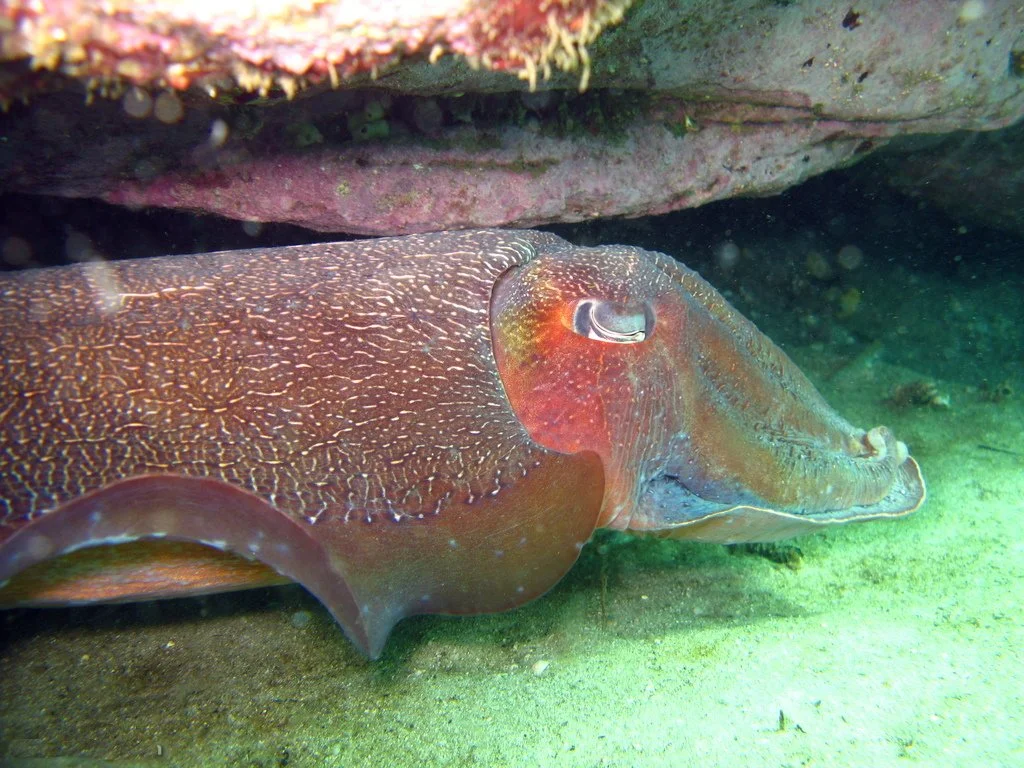
🦑 Cuttlefish
also have 10 appendages
possess an internal calcareous shell (the “cuttlebone”)
can display extremely complex changes in color and patterns
are also considered highly intelligent
.jpg)
👉 Example: the giant cuttlefish (Sepia apama), an endangered species, as shown in the image on the right.
Richard Ling from NSW, Australia - Australian Giant Cuttlefish
An Australian Giant Cuttlefish (Sepia apama). Fairy Bower, Manly, NSW
4. Why This Distinction Matters
At first glance, these animals may appear similar.
But biologically and behaviorally, there are important differences:
Octopuses, squid, and cuttlefish differ in several characteristics. Octopuses have eight arms, are usually solitary, and have a soft, highly flexible body without a shell. Squid, on the other hand, have ten appendages, are often social, and move particularly quickly through the water thanks to their streamlined bodies. Cuttlefish also have ten appendages, display both social and solitary behaviors, and have a more compact body. Unlike octopuses and squid, they also have an internal shell.
👉 Particularly important:
Octopuses are not “typical” livestock — nor are they what we would traditionally think of as “squid.”
Their:
solitary lifestyle
high intelligence
flexible body structure
make them unique — and particularly difficult to reconcile with intensive farming systems.
5. An Unusual Branch of Life
What makes octopuses particularly fascinating:
They are an example of the convergent evolution of intelligence.
This means:
Their complex abilities evolved independently of those found in vertebrates
Their nervous system functions in a completely different way from ours
And yet they demonstrate:
problem-solving behavior
memory
individuality
👉 This makes them one of the most fascinating groups of animals — and one that we still do not fully understand.
Conclusion
Octopuses are:
mollusks — but highly developed ones
part of the cephalopods — a unique group of animals
biologically distinct from squid and cuttlefish
and exceptionally complex among invertebrates
And perhaps that is the key point:
When an animal is so different from us — yet at the same time so similar to us in its behavior — we should take an especially close look at how we treat it.